
Resources
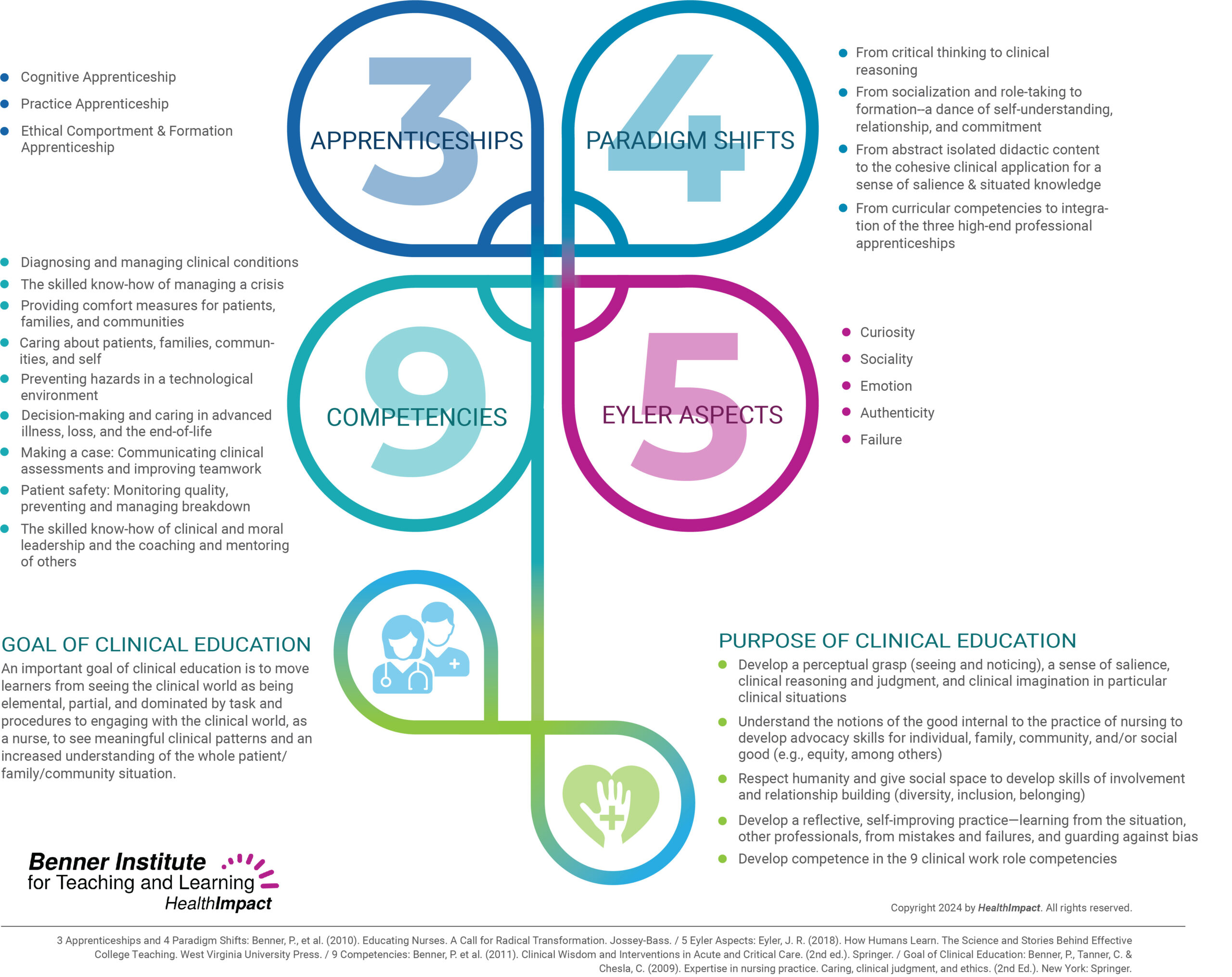
Welcome to the resources page at the Benner Institute for Teaching & Learning. The specially curated collection of resources includes articles, seminal research, and professional associations committed to the radical transformation in nursing education. Be sure to check out the free collection of webinars, narrative recordings, and links to upcoming events and conferences. The North-star represents the guiding framework for the Benner Institute’s Mission and Vision for transforming nursing education.
Establishing the “North Star” for Clinical Education to Accelerate Practice Readiness
Leaders in academia, regulation, accreditation, and practice should adopt the goals delineated in this “North Star” as being the end-points of practice formation, create learning experiences to support practice formation from novice to expert, and create meaningful evaluation strategies that go beyond traditional psychometric testing. When academia, regulation, accreditation, and practice all adopt these goals of clinical education, we contend that there will be congruence and more seamless transitions across the academic-regulation-accreditation-practice spectrum.
Open Access publication in Nursing Administration Quarterly
DAISY™ Foundation & Benner Institute’s—Narratives Educating Nurses Project
Featured resources include access to a collection of audio/visual recordings in partnership with the DAISY™ Foundation. Nursing narratives represent a crucial andragogy for the development of clinical reasoning and judgment, build the foundation for a self-reflective improving practice, and continue the journey of transforming nursing education in the 21 st century. Access to HealthImpact’s Spotify™ and YouTube™ channels is free to the public—see the links below.
YouTube Channel: Coming Soon!
Seminal Research
Educating Nurses: A Call for Radical Transformation (2009)
Clinical Wisdom and Interventions in Acute & Critical Care: a Thinking-In-Action Approach
Expertise in Nursing Practice: Caring, Clinical Judgment and Ethics
From Novice to Expert: Excellence and Power in Clinical Nursing Practice
How Humans Learn: the Science and Stories Behind Effective College Teaching
Journal Articles
Establishing the “North Star” for Clinical Education to Accelerate Practice Readiness
Trauma-Informed Educational Practices within the Undergraduate Nursing Classroom: a Pilot Study
Growing Brains, Nurturing Minds—Neuroscience as an Educational Tool to Support Students’ Development as Life-Long Learners
Key Tips to Providing a Psychologically Safe Learning Environment in the Clinical Setting
Improving Practice Readiness Among Nurse Residents
Quantifying and Remediating the New Graduate Nurse Resident Academic-Practice Gap Using Online Patient Simulation
Integrating the National Council of State Boards of Nursing Clinical Judgment Model Into Nursing Educational Frameworks
Thinking like a Nurse: a Research-Based Model of Clinical Judgment in Nursing
Webinars
Creating a Community of Inquiry in Online Learning
The webinar featured speakers Professors Holly Fiock and Glenise McKenzie. Ms. Fiock has developed the Community of Inquiry model of online learning, based on the works of earlier educators, and focused on developing social presence, cognitive presence, and teaching presence. Dr. McKenzie has been utilizing the model for over 5 years in her online courses at Oregon Health Sciences University School of Nursing, and has designed and delivered both classroom instruction and virtual clinical simulation.The webinar presented on October 21 featured speakers Professors Holly Fiock and Glenise McKenzie. Ms. Fiock has developed the Community of Inquiry model of online learning, based on the works of earlier educators, and focused on developing social presence, cognitive presence, and teaching presence. Dr. McKenzie has been utilizing the model for over 5 years in her online courses at Oregon Health Sciences University School of Nursing, and has designed and delivered both classroom instruction and virtual clinical simulation.
Effective College Teaching in an Online Environment
This webinar features speakers Joshua Eyler and Paula Gubrud-Howe. Grounded in learning sciences, Dr. Eyler’s framing focuses on the five essentials of curiosity, sociality, emotion, authenticity, and failure. Dr. Gubrud-Howe has five years of experience in a very successful RN to BSN online program from Oregon Health Sciences University School of Nursing. In a panel discussion led by Drs. Patricia Benner and Garrett Chan, the speakers discuss how to put the theory to practical use.
The Radical Transformation of Nursing Education Webinar Series
This webinar series includes three Webinar recordings:
The Formation and Everyday Ethical Comportment Apprenticeship
The Cognitive Apprenticeship
The Practice Apprenticeship
Innovative Paradigms in Nursing Education: Thinking Beyond Traditional Models
Maureen Baker, PhD, CNL, CHSE, is a Clinical Associate Professor at the University of North Carolina at Chapel Hill, School of Nursing. She is passionate about nursing education and inspiring the next generation of nurses to elevate the art and science of nursing. As an Apple Distinguished Educator, she leads the UNC SON EmpowerEd program, using iPads and emerging AI technologies to transform nursing education, enhance student engagement, and advance scholarly productivity.
Learning Objectives
- Apply principles of digital fluency to redesign nursing education experiences.
- Evaluate nursing education using a competency-based framework.
- Design a digitally enabled, competency-based learning activity